
A 50% tariff makes an effective headline because it invites a simple conclusion: costs are about to rise dramatically. The economic reality is less direct.
For Vancouver real estate, the more immediate concern is what prolonged uncertainty does to confidence.
That matters because so many real estate decisions can be delayed. A buyer can wait. A seller can hold off. A homeowner can postpone a renovation. When enough people become cautious at the same time, uncertainty becomes a market force of its own.
On August 22, the United States imposed 50% tariffs on $27.6 billion of Canadian goods. Canada has announced matching counter-tariffs. The numbers are dramatic and the dispute is serious. A 50% tariff on selected goods, however, is not a 50% increase in the cost of living, renovating or owning a home.
The eventual effect will depend on which products are involved, how long the tariffs remain, whether businesses change suppliers and how much of the additional cost reaches the consumer.
There is also the effect that cannot be found on an invoice.
The Bank of Canada reports that trade tensions are already weighing on business expectations and that the outlook among housing-related businesses is particularly weak. This does not tell us where Vancouver home prices are going. It tells us that uncertainty is already entering the decisions that shape the market.
The headline tariff rate can also be misleading. During Canada’s 2025 counter-tariffs, affected U.S. retail goods rose approximately 6% relative to similar non-tariffed goods. That was roughly one-quarter of the 25% tariff. It is not a prediction of what will happen this time, but it is a useful reminder that the announced tariff and the eventual consumer cost are rarely the same.
For Vancouver, the signs worth watching are closer to home: whether renovation quotes are becoming less predictable, whether employment conditions are weakening, whether buyers are taking longer to commit and how the Bank of Canada responds to competing pressures on inflation and economic growth.
For anyone considering a purchase, sale or renovation, the practical question is not simply whether tariffs matter. It is where they intersect with the specific property, financing, timing and market conditions involved in the decision.
That is where informed real estate advice becomes useful. If you have a move or renovation under consideration, contact me. I can help assess which risks are relevant, which are manageable and which are largely headline noise.
Jessica Smith PREC
J Smith Homes
Market Update
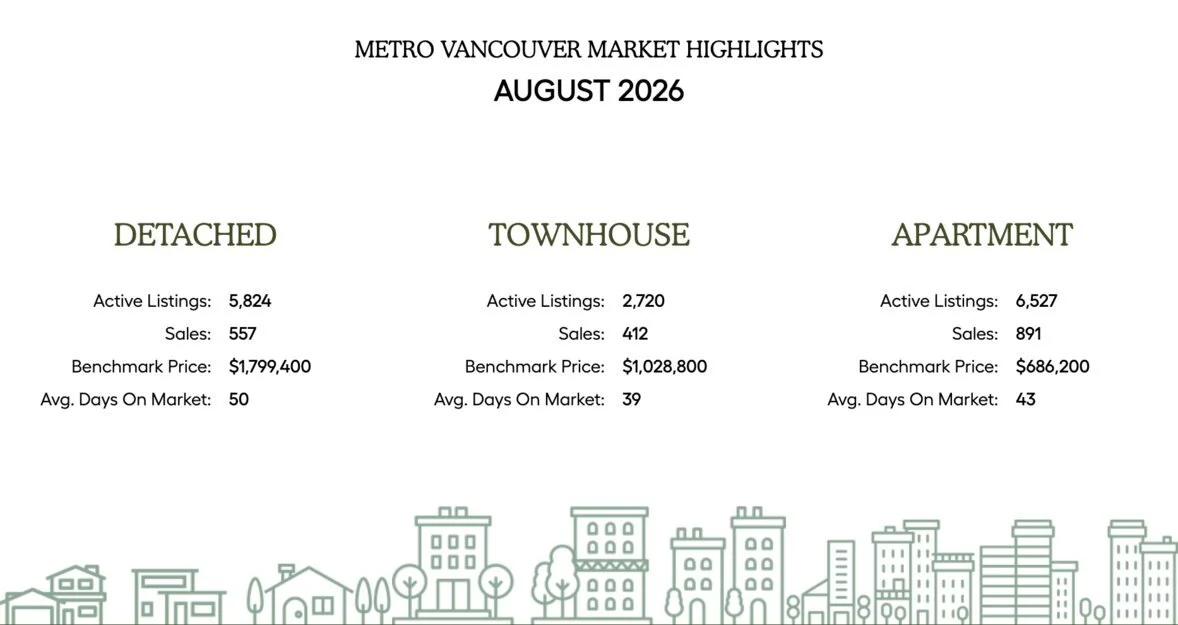
Home Sales Continue Downward Trend to Close the Summer
Home sales registered on the MLS® in Metro Vancouver* declined 4.6 per cent compared to August last year, marking the end of a summer season that underperformed the summer of 2025.
The Greater Vancouver REALTORS® (GVR) reports that residential sales in the region totalled 1,869 in August 2026, a 4.6 per cent decrease from the 1,959 sales recorded in August 2025. This was 20.7 per cent below the 10-year seasonal average (2,356).

Real Estate Q&A
Three Questions Worth Asking
Q1. Can the highest offer still lose?
A: A seller may choose a lower offer if it provides more certainty. Conditions, deposit size, completion dates and the buyer’s ability to follow through can all affect how an offer is received. Price matters, but the strongest offer is often the one that gives the seller the best combination of value, timing and manageable risk.
Q2. Can a home be too renovated for its neighbourhood?
A: A renovation can cost more than the local market is willing to return. Buyers still compare the property with nearby homes of a similar size and type, regardless of how much the owner spent. Good renovations can improve desirability and value, but the receipts alone do not determine the selling price. The neighbourhood and surrounding comparable sales still create a practical ceiling.
Q3. What can a listing’s price history tell you?
A: Price changes, cancelled listings and relisting activity can reveal how a seller’s strategy has evolved and how the market has responded. However, a reduction does not automatically mean the seller is desperate or that the home is now a bargain. The history becomes useful when it is compared with recent sales, current competition and the property’s condition.
Have a Real Estate Question?
Whether you’re thinking about buying, selling or simply trying to make sense of the market, I’m happy to talk it through.