

At the start of each year, it is tempting to look for a turning point. A cleaner approach is to look for what has actually shifted beneath the surface, separate from headlines and seasonal noise.
Compared to January last year, three things are meaningfully different as we head into 2026: pricing behaviour, inventory levels, and how buyers are responding to choice.
Pricing has softened, but unevenly.
In January 2025, Metro Vancouver pricing was still benefiting from tighter supply and more optimistic seller expectations. Over the course of the year, that support weakened. By late 2025, benchmark pricing across Metro Vancouver had moved lower, with the most noticeable adjustment in segments where inventory accumulated fastest.
Vancouver followed the same pattern, though not uniformly. Apartment heavy areas showed more price sensitivity, while well located, well priced detached homes proved more resilient. The key shift since last year is not a collapse in values, but a clear re anchoring of price expectations to current demand.
Inventory is no longer the constraint.
This is the most important change from last January. Inventory across Metro Vancouver built steadily through 2025 and entered year end at levels that give buyers meaningful choice. That shift alone alters negotiation dynamics.
In Vancouver, the shift since last year is not price driven panic. It is buyer selectivity. With more choice, expectations are higher, and only well priced, well positioned homes are moving cleanly.
Absorption has slowed, and discipline matters more.
With more homes available and fewer urgent buyers, sales to listings ratios have cooled compared to early 2025. That does not signal distress, but it does signal a market that requires precision.
Homes that are priced correctly and presented well continue to transact. Homes that rely on last year’s momentum tend to sit, adjust, and re enter the market under less favourable conditions.
A note on December data.
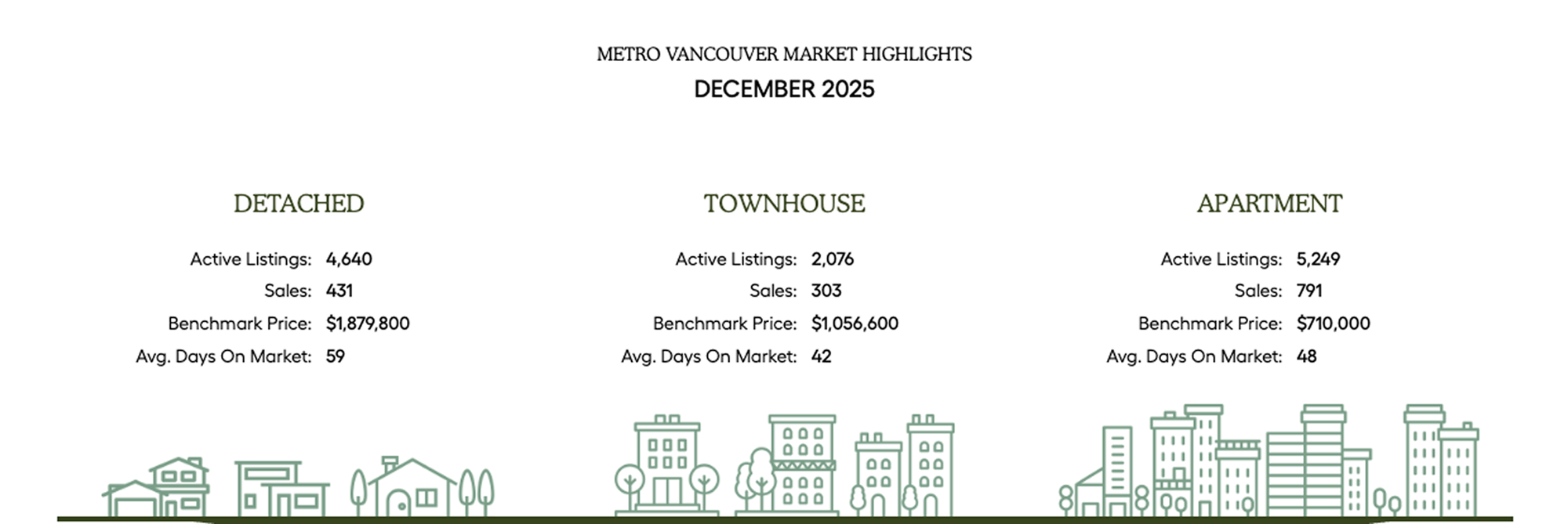
December sales and pricing figures were predictably quieter, reflecting holiday season behaviour rather than a sudden market shift. December confirms the broader cooling that took place earlier in the year, but should not be read as a trend in isolation.
What this means heading into 2026.
The most meaningful change since last year is that the market is no longer forgiving. Buyers have time, information, and alternatives. Sellers need a clear plan from day one.
This environment does not reward guessing. It rewards preparation, realistic pricing, and an understanding of where leverage actually exists.
If you are considering a move in 2026, the advantage right now is clarity. Understanding how today’s market differs from last year is what allows good decisions to stay good a year from now. We are always happy to talk through how these market shifts apply toyour specific property and plans.
Market Update
2025 saw lowest annual sales total in over two decades
Home sales registered in the Multiple Listing Service® (MLS®) in Metro Vancouver* finished the year down 10 per cent, marking the lowest annual sales total in over twenty years.
The Greater Vancouver REALTORS® (GVR) reports that residential sales in the region totalled 23,800 in 2025, a 10.4 percent decrease from the 26,561 sales recorded in 2024, and a 9.3 percent decrease from the 26,249 sales in 2023.
Last year’s sales total was 24.7 percent below the 10-year annual sales average (31,625).

Real Estate Q&A
Q1. What is the most common pricing mistake sellers are still making this year?
A: Anchoring to last year’s peak comparables instead of current buyer behaviour. Many sellers underestimate how quickly buyers adjust when they have choice. In this market, early accuracy matters far more than gradual price discovery.
Q2. What is the biggest misconception clients have about timing right now?
A. That waiting automatically improves outcomes. Timing only helps when the underlying fundamentals improve. In a market with healthy inventory, preparation and pricing discipline tend to matter more than the calendar.
Q3. What would you approach differently today compared to this time last year if you were selling?
A. We would spend more time stress-testing price and positioning before launch and less time assuming the market will correct in our favour. Today’s market rewards sellers who lead with realism and a clear plan from day one.

Let’s Work Together
Book a FREE home evaluation or real estate consultation today through the link below: