Originally published in our November 2026 newsletter. Market figures and policy references reflect that edition’s reporting period.

“I’m waiting for prices to come down.”
It’s an understandable position. Buying in Metro Vancouver is a significant commitment, and nobody wants to feel they bought too soon.
But there’s a catch: the lowest purchase price and the lowest monthly payment don’t necessarily arrive together.
The price is only half the equation
RBC’s September housing report points to a possible shift. Affordability has improved, but the bank warns that higher borrowing costs could begin eroding those gains in 2027. It also expects Vancouver-area prices to continue softening in the near term. These are forecasts, but together they raise a useful question: what if the home costs less, but financing it costs more?
Read RBC’s September affordability report
There has already been a change since that report: on October 28, the Bank of Canada announced a 0.25 percentage-point increase in its policy rate, to 2.50%. That makes it especially useful to revisit your financing numbers with your mortgage professional.
Bank of Canada announcement, October 28, 2026
That’s the part worth paying attention to when deciding whether to buy or wait.
Buyers have options. Sellers have competition.
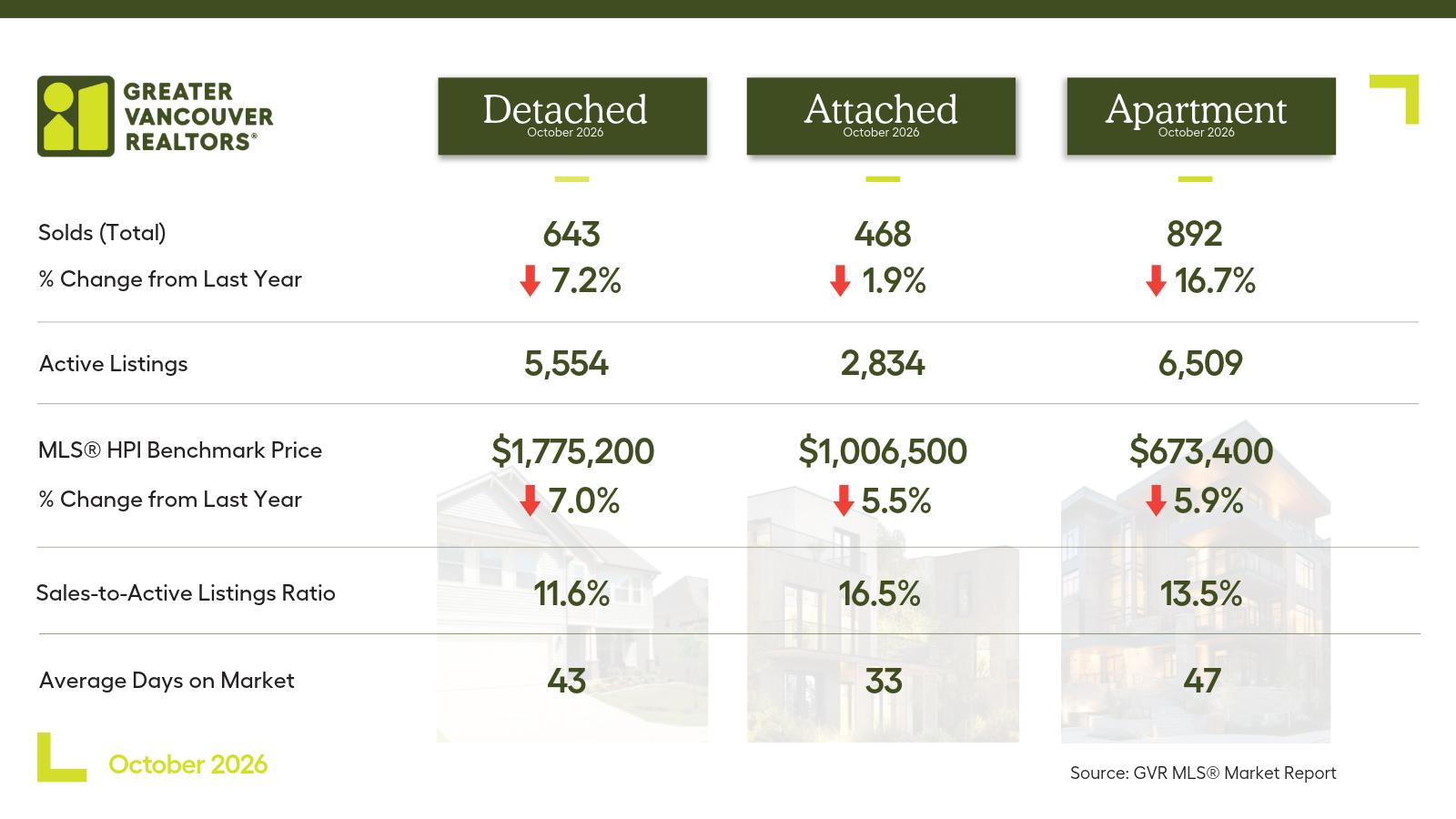
In October, Metro Vancouver’s benchmark home price was 5.2% below a year earlier. Inventory was 24% above the ten-year seasonal average, while sales were 22.5% below it. That combination suggests room for buyers to compare properties and negotiate, though the opportunity will depend on the home and neighbourhood.
Greater Vancouver REALTORS® market report
Our view: it’s worth understanding what those conditions could mean for you now, even if you ultimately decide to wait.
For buyers, ask your mortgage professional to compare a purchase at today’s price and rate with a lower price at a higher rate. Seeing the monthly payments side by side makes the trade-off much clearer.
For sellers, give buyers a reason to choose your home. We recommend looking closely at the competing listings, addressing avoidable concerns and setting a price supported by recent comparable sales. A buyer should be able to understand the value without having to negotiate their way down to it.
And if you’re selling to buy?
It’s easy to get stuck on what your current home might have sold for a few years ago.
But the home you want to buy may have changed in price too. Before deciding that a softer market works against you, look at the gap between the two properties, the costs of moving and the mortgage you would carry afterwards.
A lower sale price can be disappointing. It can also be only one part of a move that still makes sense.
Make the decision around your life and your numbers
We wouldn’t recommend moving simply because rates have risen. Equally, we wouldn’t base the decision to wait solely on the hope of a lower asking price.
Start with the home you need, the payment you’re comfortable carrying and how long you expect to stay. Then assess what the market offers.
If you’re weighing a move in Metro Vancouver, reach out. We can help you compare both sides and see whether the numbers work for you.
Jessica Smith PREC
J Smith Homes | RE/MAX Select Realty
This communication is not intended to breach any existing agency relationship.
Market Update
Buyers and sellers step back in October
Metro Vancouver recorded 2,024 residential sales in October 2026, 10.2 per cent fewer than the 2,255 recorded a year earlier. Activity remained 22.5 per cent below the ten-year seasonal average.
Buyers continued to have substantial choice: 15,688 homes were listed for sale, 24 per cent above the ten-year seasonal average. The composite benchmark price was $1,068,600, down 5.2 per cent year over year and 0.7 per cent from September.

Real Estate Q&A
What Clients Are Asking Us Right Now
Q1. Should I wait until spring to list my home?
We wouldn’t choose a listing date based on the season alone. Start with what’s for sale in your neighbourhood, how quickly comparable homes are selling and how ready your home is. Then consider your next move. Spring is worth waiting for if it suits your plans, but the calendar itself isn’t a pricing strategy.
Q2. If a home has been sitting on the market, is something wrong with it?
Time on the market is a reason to ask questions. It isn’t a diagnosis. We’d look at the asking price, listing history, property condition and comparable sales. The home may have started too high, have a narrower buyer audience or have an issue that needs closer investigation. The useful question is why it hasn’t sold, and whether that reason matters to you.
Q3. Should we leave room in our asking price for negotiation?
Some room may make sense, but there’s a difference between allowing for negotiation and pricing yourself out of consideration. We recommend choosing a price that holds up against recent comparable sales and the homes buyers can view today. Ask yourself: would a buyer see enough value to book a showing? Negotiation can only happen once someone is interested.
Have a Real Estate Question?
Whether you’re thinking about buying, selling or simply trying to make sense of the market, I’m happy to talk it through.